

Supplier Ref: 1137678


Reviewed, click:
How to identify your cine films, 8mm, 16mm and 9.5mm
Cine films come in various types and have varied over the years. The oldest is 9.5mm released in 1922 closely followed by 16mm a year later. Standard 8 came out around 1932 and Super 8 in 1965. The images below will help you understand what type of film you may have.
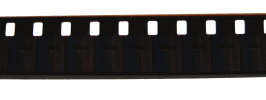
The standard 8 mm film format was developed by the Eastman Kodak company during the Great Depression and released on the market in 1932 to create a home movie format that was less expensive than 16 mm. About 40% of the film we receive is Standard 8 usually dating from 1945 to 1980. The picture quality is not as good as the later Super 8. Here is a picture of some standard 8 film and it’s reel. The spindle hole on the reel is smaller than the Super 8 film.
8 mm, Standard 8 or Regular 8 cine film
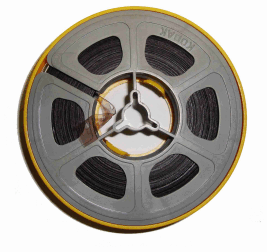
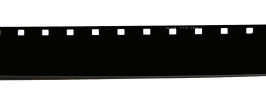

Super 8 cine film
Super 8 mm film, also simply called Super 8 was released in 1965 by Eastman Kodak as an improvement of the older standard 8 mm format. Super 8 makes up the remaining 60% of the 8 mm film we transfer, typically dating from 1967 to 1985, but it is still in use today..
The film is 8 mm wide, exactly the same as the older standard 8 mm film, and also has perforations on only one side. However, the dimensions of the perforations are smaller than those on older 8 mm film, which allowed the exposed area to be made larger. The Super-8 standard also specifically allocates the rebate opposite the perforations for an oxide stripe upon which sound can be magnetically recorded. The pictures here show the 3 inch reel which is very similar to the standard 8 reel but notice the larger spindle hole. The upper picture is Super 8 without the sound stripe and the lower picture shows the sound stripe enhanced yellow for clarity, it normally looks copper coloured.

16 mm cine film
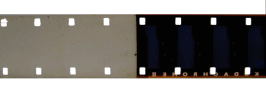
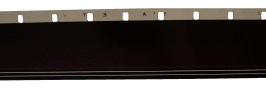
16 mm cine film was introduced as early as 1923 by Eastman Kodak as an alternative to the expensive professional 35 mm film of the time. By the 1930s the addition of an optical soundtrack boosted the sales of 16 mm cine film and it found it’s way into the professional market place due to it’s high quality image and sound. Much use was made of this format during world war II. The reel on the right is a 4 inch 100 foot 16 mm reel, the spindle hole has a single keyway. The photos of the film on the left show, top double perforation silent film and bottom, single perforation with optical sound track. There was also a magnetic oxide sound track available in later years. At Timeless Moments we are one of the few companies in the world able to transfer both optical and magnetic sound for 16 mm cine film.

9.5 mm cine film
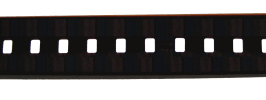
9.5 mm film is an amateur film format introduced by Pathe Freres in 1922 as part of the Pathé Baby amateur film system. It was conceived initially as an inexpensive format to provide copies of commercially made films to home users, although a simple camera was released shortly afterwards.
It became very popular in Europe over the next few decades and is still used by a small number of enthusiasts today. Over 300,000 projectors were produced and sold mainly in France and England, and many commercial features were available in the format. 9.5 mm is the least common film we encounter at Timeless Moments, however we can of course transfer it to the format of your choice, the picture quality is usually quite good, almost up to 16 mm standard and far superior to 8 mm. The reel looks similar to the 16 mm reel with a single keyway in the spindle, however, the reels are normally metal and do not have the graduations showing remaining feet or metres as have the more modern plastic reels. The image here is of a strip of 9.5 mm film.

Reel Sizes
The following reel sizes are approximate as are the running times. Reel sizes can vary by manufacturer, however, these tables will give you a reasonable idea of the footage and running time of your films. There are also much larger reels available, for example, 16 mm goes as high as 2300 feet. Remember that Timeless Moments only charges you for the exact footage on your reel, we do not price to the nearest hour or reel as we believe this is unfair. We can be so accurate because our telecine machines have digital footage counters built in, if other companies cannot offer this then you should be wary of their equipment as it probably isn’t a professional telecine.
